That is always one of the biggest questions when it comes to welcoming pet pigeons into your home. Whether you will have a singular pigeon as a companion, or welcome multiple? With little information on how to navigate this choice online, I thought it would be good to touch on based on my experiences having kept both a companion pigeon and a pair for a few years (and then 70!) As such, this is more of an exploration rather than a list of facts, a lot of the advice here is based on my experience, and one should absorb this information with such awareness. This specific article will not cover keeping more than two pigeons, as this will have a separate article that I will link here when complete shortly.
There is no doubt that the pigeon husbandry world is going through a revolution- with more people (especially younger folk) inclined to keep pigeons as beloved household pets rather than the more standard historic practices of keeping them for racing and exhibition. Of course the concept of pet pigeons isn’t new, but there has definitely been a significant shift in the last decade or so that has encouraged more people to adopt single “companion pigeons” into their home. I believe that this has been influenced by our use of social media, a lot of people including myself got sucked in through cute videos going viral online of a cute little bird being squished and handled. People see this- and go “wow this is so cute, I want one.” and tada, welcome to the pigeon community.
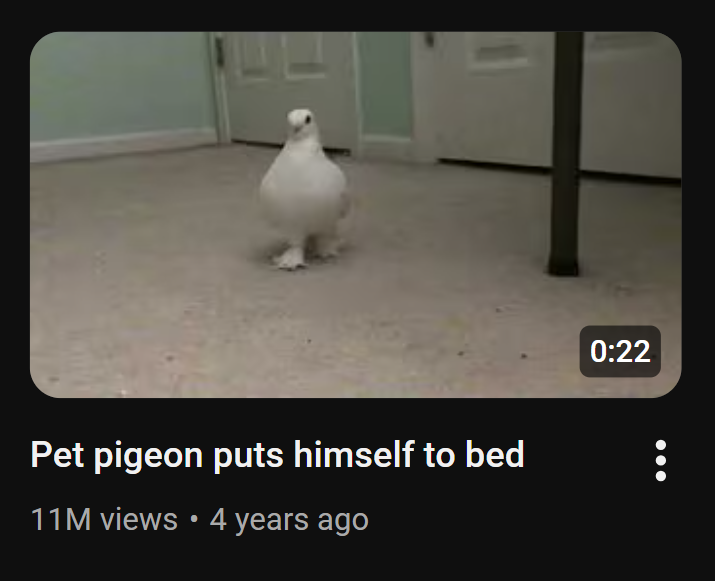
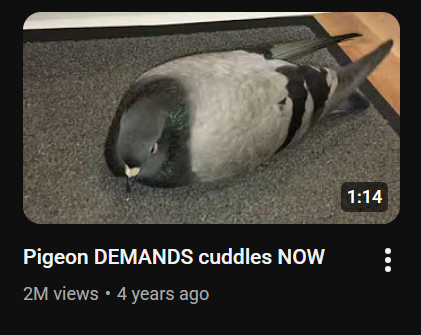
Videos of affectionate pigeons rack up hundreds of thousands of views online
Why has this question become complicated?
In the future, I would like to conduct a full analysis on this, but in short: the pigeon’s rise to popularity on social media has proven to be a double edged sword. The amount of attention pigeons have been getting recently has been amazing in raising awareness about our feathered friends and beginning to reduce the stigma around them. However, the content being produced and going viral on social media platforms mostly all falls into the same category- it is all videos of pigeons being very affectionate and cuddly. While these videos have certainly helped people see pigeons in a more positive light, they often leave out important context about their social needs and behaviour. As a result, there is often a lack of understanding between the various ways one can keep a pet pigeon and the different outcomes of having a relationship with them.
This leads to an important consideration for everyone: should I get one pigeon or a pair?
Owning a Pair of Pigeons
Misconceptions
There is a very common misconception floating around that a pair of pigeons will never like you and you will never form a bond with them. Whilst your bond with your pair will be different to how it would be if you were their “partner” as with a singular bird, there is still very much a bond present, and the idea that you won’t form a bond, period, is false. Pigeons who are bonded to each other will still seek you out for social enrichment or simply for non-romantic companionship.
Something I also see new owners getting confused about is nesting behaviours. One well known example of this is where the bird sits down and goes woo woo woo asking to be coddled. Sometimes owners who are new to pairs expect their pigeons to display this behaviour to them- however it is mostly reserved for true bonded partners. This sort of ties into the first point where owners expect a pair of pigeons to display the same kind of behaviours to them as with a single bird, but oftentimes these kinds of behaviours will be reserved for their one and only. Note: Don’t get nesting behaviours switched up with social behaviours like contact calling. This is touched on further down.
This doesn’t mean you can’t have a relationship with them though- pigeons are flock animals and have a dynamic with everyone! This is a factor that is often overlooked when considering a pair.
Social needs of a pair
Having each other as company means you don’t have to spend upwards of seven hours with them to meet their social needs each day. A pair of pigeons should be considered for people who have a busy lifestyle either with work or studies where spending a considerable amount of time with them each day might be tricky. They also have the exact same housing requirements as a singular pigeon- so there is no need to size up, although the bigger the better anyways.
If you adopt two birds that aren’t already paired up, there is the chance that they won’t bond. Which is okay as well, as mentioned, pigeons like to be social with everyone regardless of relationship status. In these cases they can often co-exist in the same space as long as they have separate cages to call their own.
Breeding realities
One thing you do have to watch out for with a pair of pigeons (who 99/100 times are a male/female pair) is that they will lay fertile eggs. Pigeon pairs generally lay a clutch of 2 eggs monthly, and if you allow your pair to incubate those eggs, you will be overwhelmed with pigeons very quickly. Unlike exotic species of birds, pigeons are domestic and even if you alter environmental factors (light, setting, etc) they are still very likely to lay. For this reason, we do generally allow pairs to lay and brood (if there are no health issues) and rather than discouraging the behaviour, switch out the real eggs with fake eggs “feggs”. This means the pigeons can go through their natural cycle and “play house” with their feggs. Pigeons love collecting bits and bobs to add to their nests whilst they are brooding, and they don’t know any difference between the real and fake eggs. Generally they will abandon the clutch after 3ish weeks once they realise they won’t hatch.
During this time, the pigeon who is on nest duty will be quite crabby as they are solely dedicated to protecting their eggs. It is normal for the pigeon to get annoyed and peck you if you try to disrupt their brooding activities. They will want to be left alone and you have to respect that, but if the other pair is still up and about, you can use this time to connect one on one.
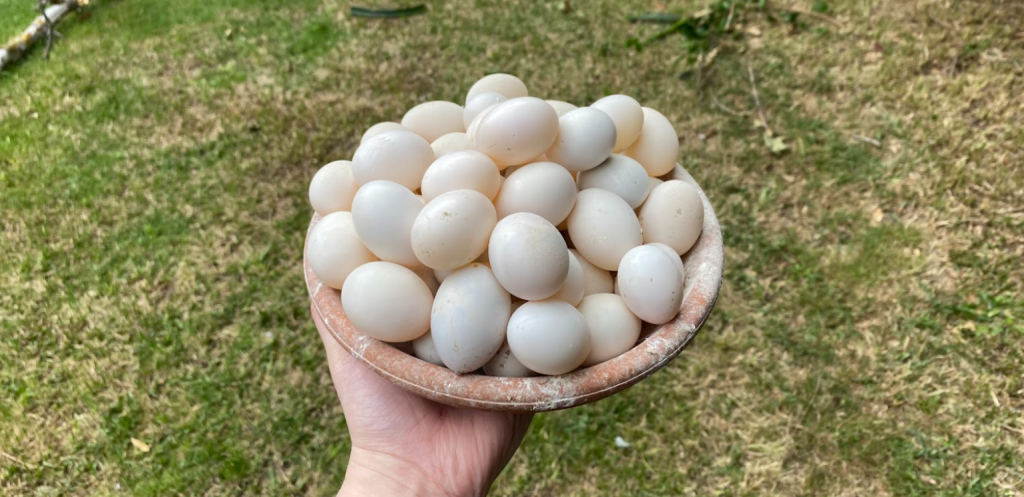
This is what one week of egg control looks like for us!
How can you work on bonding with your pair?
Some ways you can help reinforce your bond with your pigeon couple is to provide them with lots of material for their nests, hand feed them pigeon “treats” like safflower and peanuts, and be sure to interact with them lots. Interaction doesn’t have to be direct, even sitting in the same room is enough. Watching them court each other and build a house is very amusing.
So what can you expect from a pair?
My first two pet pigeons, Freckles and Ghost, were a pair. To be quite honest I hadn’t done much research into the differences between keeping a pair versus a singular bird, so I was very much learning everything as I went along. They lived in an aviary outdoors, and I always went out to handfeed and spend time with them daily, additionally bringing them indoors to interact with them even more. Through doing this, it didn’t take a lot of work for me to form a friendship with Freckles and Ghost (if I had to guess? 1-2 months?). It wasn’t long after I had them where it got to a point where they would fly to my head and shoulders freely and enjoy being taken out to different places and spaces. Freckles particularly enjoyed my presence either as a fancy perch or sparring partner. They became my ambassabirds, I took them to petstores, parks, and the like, raising awareness about my amazing pet pigeons!
So I one hundred percent did have a special bond with these two, it was just different from the one I would share with a pigeon that was directly bonded to me. Neither Freckles nor Ghost would ever call me over to cuddle them, and I was able to handle them rather freely but never got that begging and melting behaviour that they displayed with each other. This didn’t mean that I wasn’t allowed to touch them, but rather I just had to be mindful of their boundaries.
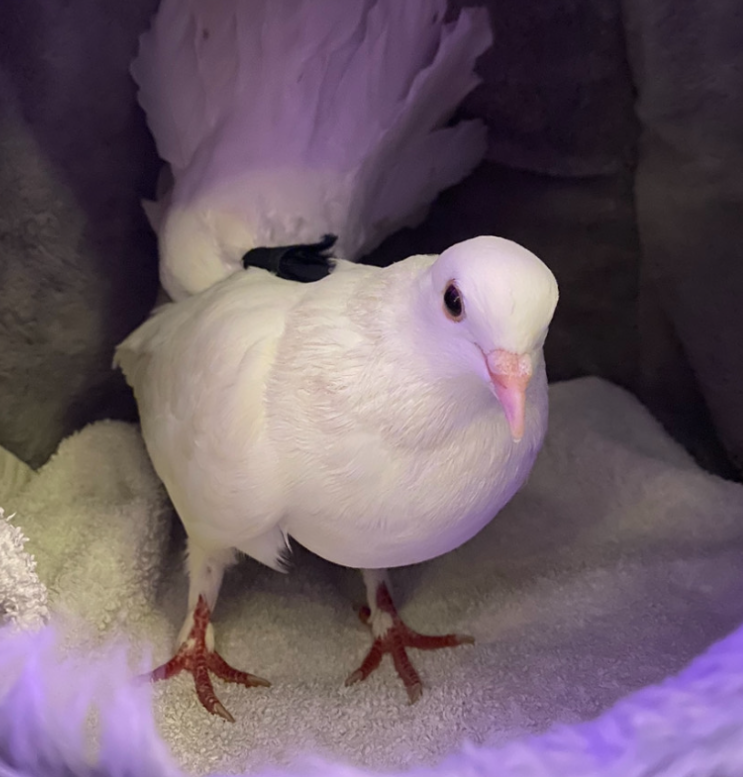
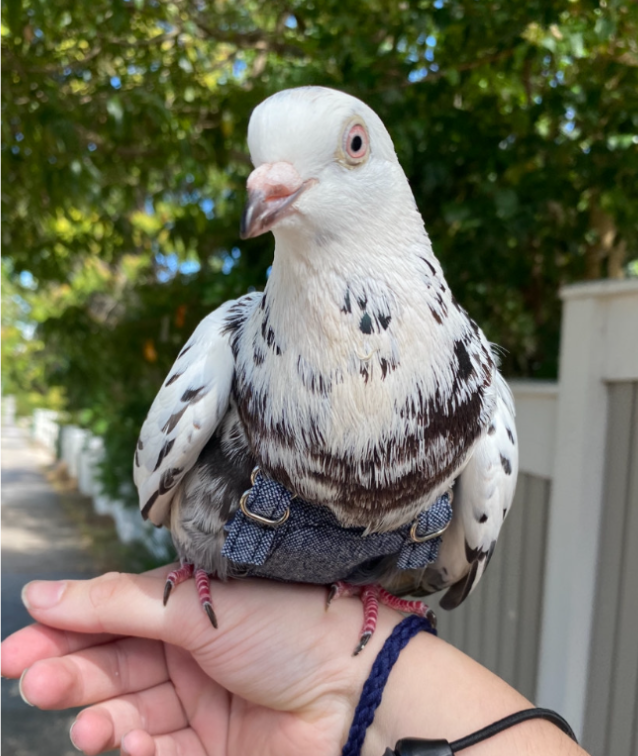
Freckles and Ghost
Owning a Single Pigeon
As one of the original domesticated birds, pigeons adapt very well to home life and being the sole pigeon of the household. However this doesn’t stop the fact that pigeons are very social flock animals that will require lots of enrichment from their flockmates – whether they are feathered or not!
Social needs of a single pigeon
Something people should recognise: not all pigeons are made to be singular companion birds. This is why our rescue has some birds listed as needing to be adopted with a friend or in an aviary. Whilst you can work with pigeons and their fears, some pigeons have reasons where it cannot be worked on, and sometimes you have to accept that- or be willing to understand it might take a very long time to get them to a place where they are comfortable with human companionship. This doesn’t mean these pigeons can’t be beloved indoor pets, but rather that their owner has to be aware of their boundaries and/or potentially be open to adopting another feathered friend so the pigeon can still have adequate social enrichment.
The big thing for single pigeons is that they must have a few hours, often 7 or more, of direct daily interaction to fulfill their social needs. When you have a pigeon who is emotionally shut down and absolutely unwilling to interact with you or their environment one bit, it isn’t great for them. There is a bit of leeway for this as the majority of pigeons, even if they have been advertised as friendly, will take a few weeks to months to warm up to their new owner. It is important to understand there is a blurry line between an okay level of nervousness and unhealthy “I am shutting down and unable to cope” level. (This is sometimes why we have birds on hold to continually assess their temperament, or have them out in foster homes before adoption)
Single pigeons thrive in an environment where their owners are home a lot during the day and have a significant amount of time to dedicate to their pigeon. This isn’t to say people who work full time can’t own a single pigeon, but they should assess how much time they realistically can provide the pigeon.
Behaviours to expect
Pigeon behaviour, especially at first, is a hard language to interpret. If you are having trouble, always reach out to trusted and experienced sources to help determine a way forward.
Bonded pigeons potentially can get very attached to you and may develop an immense need to be with you 24/7 which might look like flapping on their cage bars like a monkey and doing lots of contact calls. Contact calling is what pigeons do when they well… want to make contact with you. It is like us as people talking in a room. In bonded birds this will be a call to a nesting location which means “hey come and cuddle me” – but unbonded pigeons do it as well as a pro-social and self soothing behaviour. Pigeons can (and will) contact call all day. This is something that prospective owners should also consider, because a lot of sources say that pigeons are exceptionally quiet. Whilst they do not scream at the decibels their parrot counterparts do, they will go “woo woo woo” every day… and night. I always tell people to mimic the call back because it makes them feel safe when they can hear another voice, and is a really good way to initiate foundational bondwork (this works for pairs as well). If they are particularly chatty, covering up the cage with a towel or blanket at night can help relax them.
A pigeon who is bonded to you may exhibit driving behaviour also. This is more common in males but it does happen with the ladies too. Essentially the pigeon will bite you a lot whilst fanning out their tail. This is not out of hatred, but is instead the pigeon saying: “Look at me, I am so big and strong. I can protect our babies. Please date me” This can be a bit confusing as well for new owners. Driving behaviour is different to imprinted behaviour, but imprinted pigeons are a whole entire different topic that will not be discussed today. And don’t think there’s not a catch with the ladies either! If you have a hen, you also might be expected to take on egg-sitting shifts! Pigeon parents share their nest duties equally and your pigeon will need a break to defecate and eat. Even if you are bonded with your lady pigeon, it is likely she will be crabby on the nest also, and not really want much to do with you for 3 weeks.
So to sum it up there is significantly more work and nuance when looking after a singular pigeon. It can be really overwhelming.
What can you expect from a single pigeon?
Despite having pigeons for many years, it hasn’t been until very recently that I have dipped my toe in the water (thrown in the deep end) of owning a pigeon bonded to me long-term. Over the years we have had numerous birds in care that have been very friendly and keen to bond, but these birds were always destined for adoption and given their popularity, were never around here for too long. And then a silly goose of a pigeon called Turd decided to welcome himself into my life. Note that I did not say I welcomed him.
To this day I still have no idea where he came from, but upon handling him for the first time he showed great interest in pecking my hands. I thought I would work on him a bit so he could be adopted out as a socialised pigeon with the potential of becoming a companion to someone else. At first, Turd was rather shy. He was very hand nervous and always flew away when my fingers got too close to him.
It only took a little under two weeks for Turd to “marry” me by asking me to nest with him in a little hidey hole in his cage. But do be aware it can take up to months or in some cases even years to get to this stage with a pigeon and everyone is different. Turd is also a bit of a special case, because he was absolutely smitten by me, and followed me everywhere. When I initially rehomed him to a friend, he got very stressed and upset. He was frantically looking for me and flapped around to the extent where he got himself hurt, and had to be returned the next morning. So I like to think he loves me very much.
In my case, Turd is basically a pocket-sized coo machine. I’ve filtered it out as white noise now, but whenever I am on phone calls or take him anywhere, everyone is just like : does he ever stop!!?? Coo intensity varies from pigeon to pigeon and if it is a concern for you, do ask questions regarding noise level to the organisation/person you are getting the bird from.
For the last few years of my life I have dedicated a fat chunk of hours daily to letting him out and spending time with me. Normally this consists of Turd making a mess of my room for an hour or so talking to different inanimate objects before flying onto my shoulder and wanting to be manhandled for another hour. Then he will be cheeky and start driving and pecking me, chasing me back to his cage where we will then sit for another while together cuddling. It is amazing to share such a deep bond with a bird but it is definitely something that requires a lot of maintenance. No matter how tired, busy, or sick I am, I must commit myself to Turd every day!
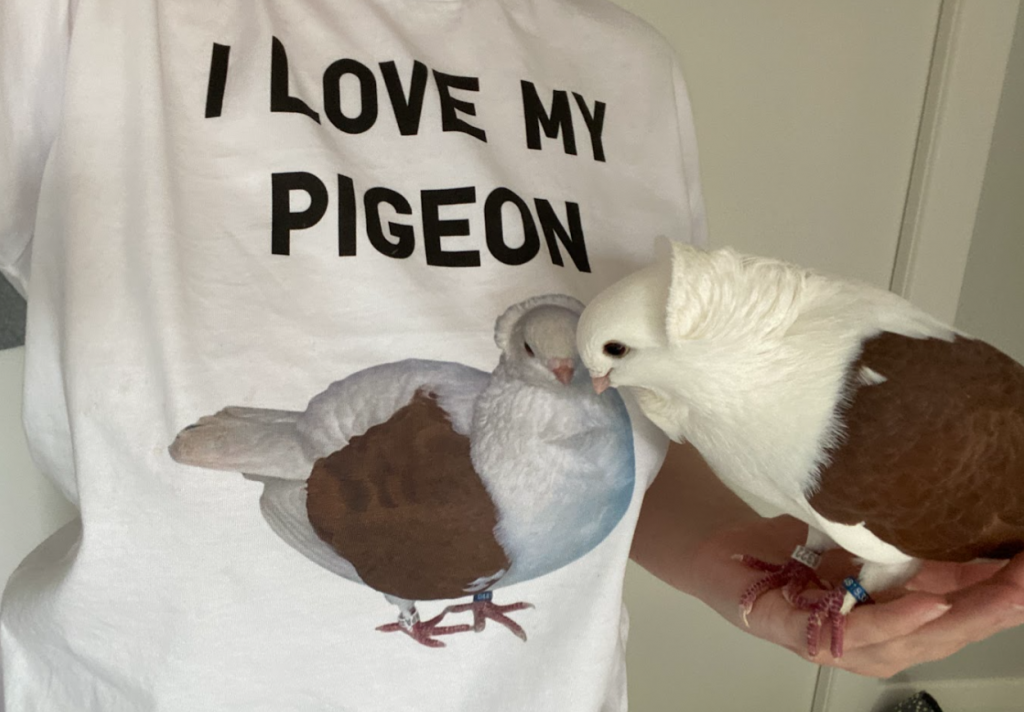
Turd
Conclusions
For convenience, I have done my best to condense this information into a table:
| Aspect | Single Pigeon | Pigeon Pair |
| Social needs | Very high | Low (regulated between birds and people) |
| Daily interaction | 6+ hours | 30+ minutes |
| Egg laying | Possible (hens) | Very likely, fertile |
| Tolerance to human absence | Low | High |
| Risk of behavioural frustration | High | Low |
| (generally) Suited for: | People who: – Are retired – Work from home – Have lots of free time – Have a stable schedule | People who: – Are students – Work full time – Have a varying schedule |
I hope this exploration has been of help to you!

Leave a Reply